
Trying not to try: effortless action and materiality

I recently found myself repeatedly returning to a short piece titled “Materiality in Printmaking and Painting: A Nexus of Process and Meaning,” written to frame the upcoming exhibition ‘Edition 2: Materiality’ by NoPlace Art. It prompted me to reflect on one of the primary ways I have been painting in recent years—a method that involves floating thinned paint on a bath of water and dipping a support onto or into the surface. Much like marbling, the process is almost entirely governed by the behaviour of the materials themselves, which is why I feel compelled to write about materiality.
For me, ‘materiality’ refers to the physical substances artists use to bring ideas to life. In my case, these materials are very thin oil paints transferred onto primed or unprimed wood, paper, or card. The materials are everything in this process, and the choices are surprisingly limited. Commercial marbling inks exist, and Japanese Sumi inks can also be floated, but both are restricted in colour range. I recently saw a painting by Thom Yorke and Stanley Donwood that used floated enamel paint, but enamel creates a much heavier impression and lacks the ethereal qualities I enjoy.
When I try to write about materiality, I often drift into discussing process or intention—or worse, end up writing something that feels like ‘art bollocks,’ which never feels authentic. Process is straightforward enough to describe, but risks becoming dull. Intention is more interesting, especially because one of my intentions in making this work is to let go and enter a state of Wu Wei, the Chinese principle of effortless action. I first encountered Wu Wei years ago through Tai Chi, and it continues to intrigue me. Yet achieving effortless action is inherently paradoxical—trying not to try is impossible.
The moment during which I aim for even a glimpse of Wu Wei is the actual dipping. It feels strangely momentous to commit those drops of pigment to a support, and my anxiety rises each time. I try to empty myself, to quiet my mind and body, to detach from the outcome—but it’s impossible. Every time I lift the support from the water, my heart either sinks or soars. Often, I expect disappointment before I’ve even begun, which probably tells you more about me than I would like. And here I am again, circling back to intention and process. What is it about materiality—about pigment, surfaces, textures, application, even smell—that pulls me in so strongly?
The transformation of the oil pigments from floating on water to resting on the support is undeniable, and my feelings about each state are different as well. Adding the oil to the water is a sensual act, full of hope and anticipation, which complicates any attempt at Wu Wei. My supports are prepared in advance—primed, sanded, sometimes underpainted—and while I may have a notion of how I would like the pigment to disperse, I’ve learned not to hold too tightly to that hope. Too many disappointments. Occasionally I am delighted, but often that delight arrives only after a period of grumpiness and long reflection. Many ‘unsuccessful’ dips eventually become the beginnings of something better, though in the moment I am, admittedly, quite frustrated.
There is something ethereal about the paint once it is floated onto the support. The drops seem suspended, not fully attached. Seconds earlier they were drifting on water, and then instantly they are fixed—records of movement and process. Even once dry, the pigment still appears to vibrate with a kind of energy or vitality.
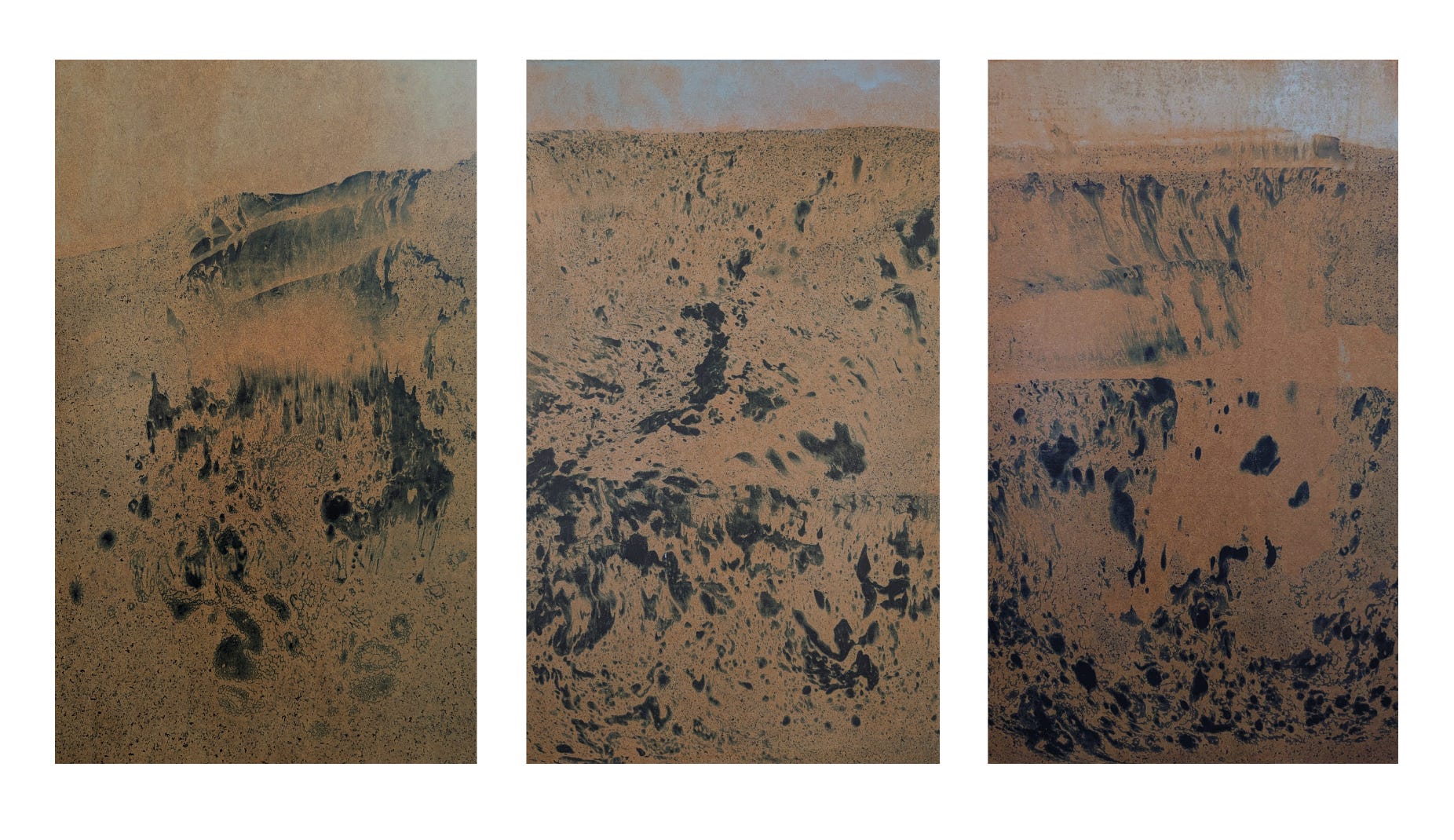
So much of this way of working depends on the material properties at the precise moment of dipping. I no longer think of it as marbling. If the paint isn’t thin enough, it refuses to float or disperse. If it’s too thin, it disappears, only to reappear—uninvited—on a later piece. Leave the paint too long on the surface and it begins to form clumps, or travels to the edges, mingling with remnants of past colours. Sometimes the paint settles into patterns resembling the interior of a cell. If I want to preserve the swirling marbled patterns, I have to act quickly, but that haste can cause smearing or skidding, and the results often betray my panic. Even the wind can blow the pigment, or the water can shift if I accidentally (or intentionally) kick the bath.
The relationship between thinned paint, support, and water is deeply physical and hinges in part on the principle of surface tension. A recent series of works titled ‘Capillarities’ grew out of this—an attempt to express how capillary action moves the paint across the surface. Each dip is different. I have spent hours trying to standardise the process, to make it repeatable, but I simply cannot. It is not repeatable in the slightest.
As an artist, I consider myself resilient—our work demands it—but removing yet another certainty makes me question my motives. Do I enjoy the struggle a little too much?
Beyond the variable thickness of the paint, the quality, density, and weight of the pigments themselves create differences. The water’s surface tension shifts subtly depending on factors like temperature, wind, or even water treatment. The water changes if I agitate it. All of this contributes to a process shaped by countless uncontrollable factors.
Perhaps that is what makes this such a deeply material way of working. Each dip captures an unforced, singular moment—one that unfolds naturally and cannot be replicated. When writing about the triptych ‘Capillarities,’ I felt the following words captured its nature: “Just as rocks surface from peat bogs or shale fractures from a cliff face to reveal a new texture, the paint reveals itself through minimal intervention. These pieces are the product of an arrested, yet living, moment.”
And yes—I’m still wondering whether I enjoy the uncertainty a little too much.
That was a fascinating read, thank you. As a (very) amateur and novice watercolour painter and dabbler in cyanotype, I definitely relate to that feeling of liminality, uncertainty, disappointment and occasional relief.
X